

Berdenesh Hills
Citadel in the Mediterranean

Shaped by the Mediterranean landscape of southern Albania, the “Berdenesh Hills” project takes shape as a contemporary citadel where sea, light, and topography define the architecture. Studio NOA designs an ensemble of terraced volumes in earthy tones, capable of translating the territory's identity into a harmonious living environment.
Following their work on the “Puzzle” tower in central Tirana, Italian studio NOA engages with a new challenge in southern Albania, turning its attention to Saranda. Here, the sensory qualities of the Mediterranean—the light, the sea, and the distant outline of Corfu—become central to shaping the spatial and formal identity of the new residential project.
The journey to the project site proved to be a significant source of inspiration. The route traces a clear transition from Tirana’s dense urban fabric to a low-density rural landscape, dotted with hills covered in Mediterranean scrub.
“We were deeply impressed by the coastline of this region: it unfolds as an inward-turning spline, marked by continuous inlets, large bays, and small coves, all framed by the silhouette of Corfu on the horizon.”
Lukas Rungger
Architect and NOA founder

Beyond Saranda—a town that has experienced a construction boom since the 1990s—the landscape is defined by the interplay of land and sea, expressed through jagged cliffs and small sandy inlets. Behind the project site, exposed stone slabs form a tectonic landscape of projections and recesses. This distinct, tense and articulated territorial identity plays a fundamental role in shaping the project.

The project site is located in a region rich in history, where traces of ancient castles, fortresses, and bastions are scattered across the landscape. Analysis of both natural and anthropic elements allowed NOA to define a grammar for a new settlement model—one capable of interpreting the beauty of the place while establishing continuity with its historical context.


"Although the predominant architectural typology in the coastal town of Saranda today is the tower, for this project we sought to reconnect with the traces of the past. We envisioned the creation of a new small neighborhood in form of a citadel. Like its historical counterparts, this contemporary citadel develops around a focal point: the central piazza. However, unlike ancient Greek, Roman, or medieval fortresses—the most famous Albanian example being Argirocastro—its perimeter walls, formed by a variety of buildings, open outward in a continuous search for connection with the surrounding environment."
Andrea Dal Negro
Architect
Further integration with the landscape is achieved through roof planes at varying heights, which rise and fall in response to the site’s topography. This approach shapes an architectural landscape that blends seamlessly with its natural surroundings, forming an almost amphitheatrical configuration centered on the main square. The functional program comprises approximately 250 apartments and a hotel distributed across 26,000 m². At the heart of the development, the central square unfolds across five terraced levels and incorporates a community pavilion. A Mediterranean park, characterized by rich and flourishing vegetation, extends across the entire site, reinforcing the project’s relationship with the landscape.


Given the coastal context, where outdoor living is central, every apartment is designed with private open space. Each building volume, with a maximum height of six stories, tapers gradually at its shorter sides, creating expansive terraces accessible to edge apartments. Meticulous attention was given to framing views: the sea serves as a constant scenic backdrop. To reinforce this connection, opaque parapets are lowered to align with the living areas and replaced by slender metal rods, offering unobstructed views. This design ensures the sea remains the defining element of the project’s quality, both within the apartments and in the central public space.
The project has received preliminary design approval and is currently in a further phase of development, with construction planned to begin in 2026.

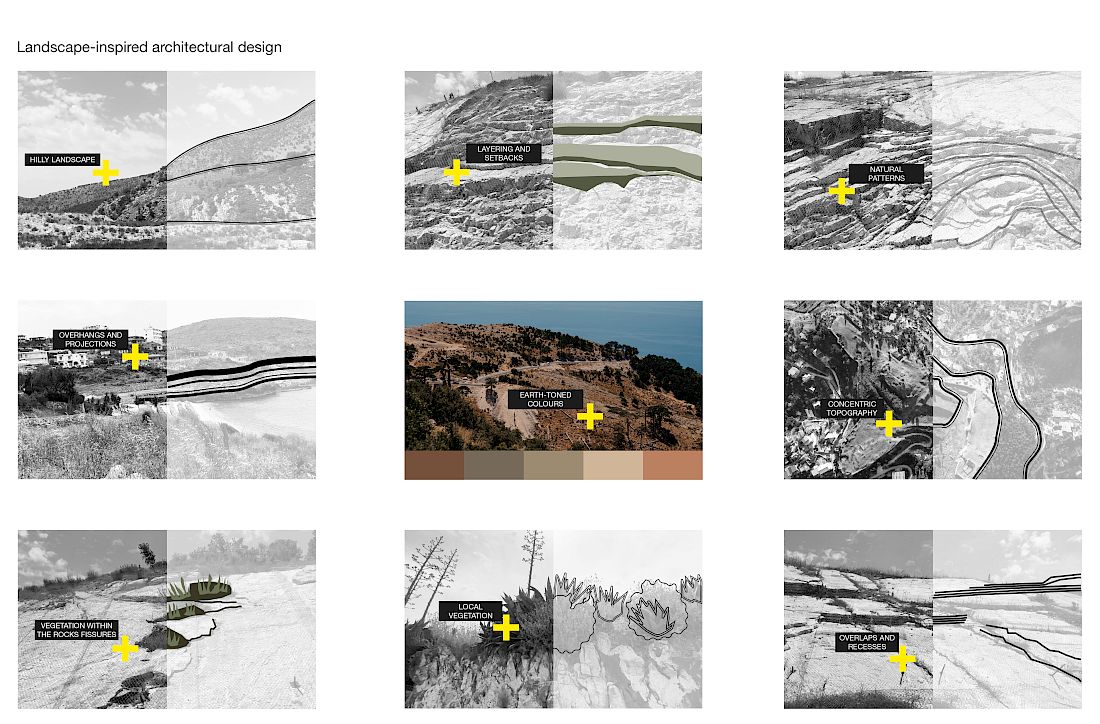
“The facades are characterized by bands of warm, earthy tones in raw plaster, echoing the lines of the surrounding landscape. These organic forms create a dynamic play of projections and recesses that extend from the base to the top of the buildings, breaking the rigid horizontality of the floors and making the reading of slabs—typical of multi-storey apartment buildings in Saranda—impossible. The terraces provide generous outdoor spaces for residents and reinforce the buildings’ integration with the environment, softening visual impact while maximizing natural light”
Lukas Rungger
Architect and NOA founder
facts & figures


